+977-9856049996

By Dr. Saurabh Tiwari, Volunteer Medical Officer, Smart Health Global
The Evening Had Been Quiet
I had just come off duty.
The kind of quiet that settles over a long day when you finally let yourself stop — I was preparing to unwind, making tea, slowing down. The mountains outside were dark. Darchula in the far west of Nepal has a particular stillness at night, the kind that makes it hard to imagine urgency.
Then my phone rang. It was 8:23 PM.
The voice on the other end was trembling. A healthcare worker from Uku Health Post — a small facility in the rugged Malikarjun Rural Municipality — was speaking fast, trying to hold herself together. I could hear it: the particular pitch of someone who knows exactly how serious the situation is and is fighting to stay calm so she can be useful.
A young woman had collapsed. She was 22 years old. She was in her 27th week of pregnancy. She was having seizures.
Her blood pressure was 180/110 mmHg.
I knew before she finished the sentence. Eclampsia — one of the most dangerous complications of pregnancy, and one of the leading causes of maternal death in Nepal’s remote districts. A condition that, in a well-equipped hospital with a specialist on hand, is manageable. Here, on a dark night in Darchula, three hours from the nearest surgical unit, it was a race against time.
I put down my tea.
Who She Was
Before I tell you what happened medically, I want to tell you who she was.
She was from the Raute community — one of Nepal’s most marginalised and historically underserved indigenous groups. A people who have lived on the edges of formal systems for generations: the edges of the economy, the edges of governance, and — acutely, measurably, fatally — the edges of healthcare.
For a woman from the Raute community in Darchula to be in her 27th week of pregnancy with no documented antenatal care, no specialist she had ever seen, and no hospital within three hours was not an exception. It was the rule.
She had no idea that tonight, a doctor would be with her — from a hundred kilometres away, on a small screen, in real time.
She had never expected that.
What We Did
The healthcare worker at Uku Health Post — I want to be clear about this — was extraordinary. She was not a doctor. She had not been trained for this specific emergency. But she was present, she was capable, and she did not panic. That saved a life just as much as anything I did.
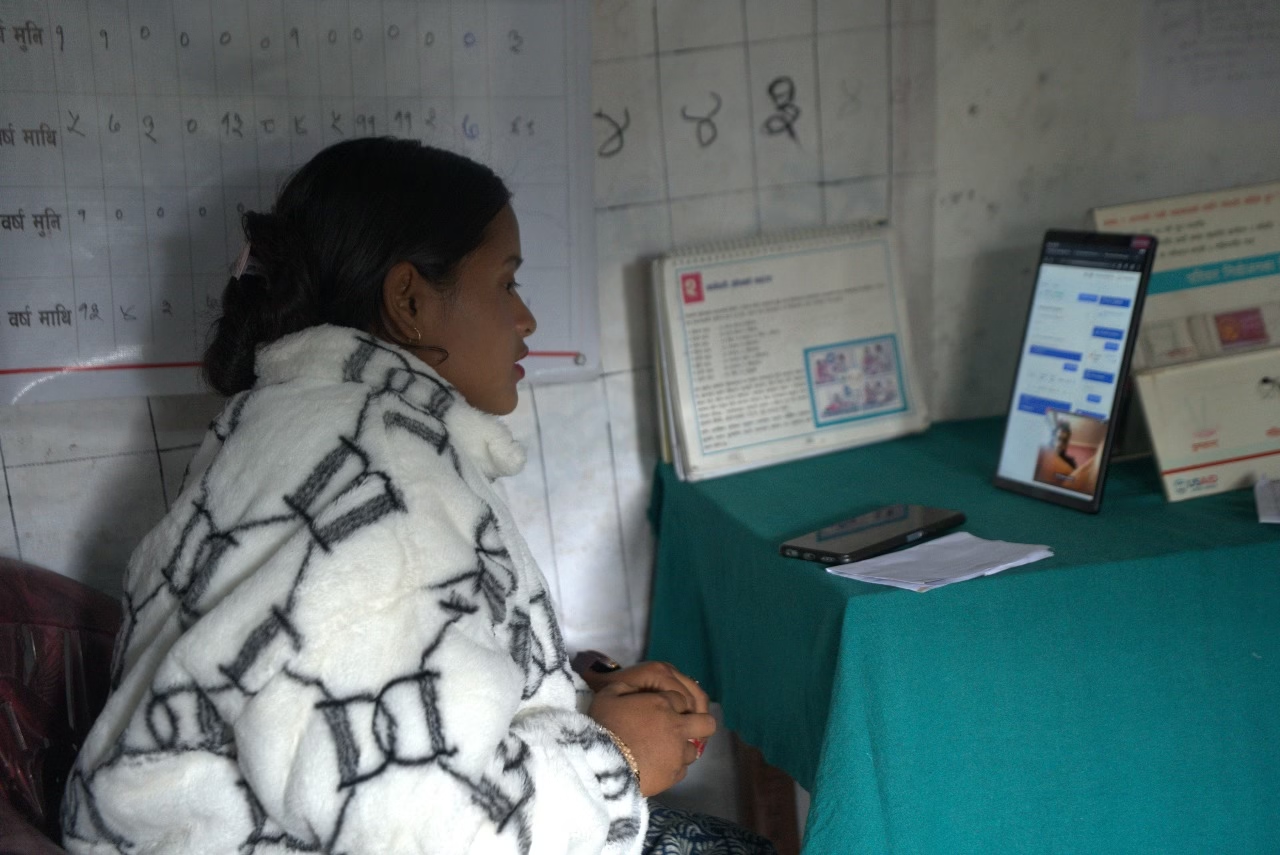
I guided her through each step using Smart Health Global’s telehealth platform, watching her on the screen, talking her through it in real time.
First: position. We moved the patient into the left lateral position — lying on her left side — to relieve pressure on the major blood vessels and optimise blood flow to both mother and baby. This one step, done correctly and immediately, buys time.
Then: medication. Following the Pritchard regimen for eclampsia management, the healthcare worker administered the loading dose of magnesium sulphate. Slowly. Carefully. Correctly. Magnesium sulphate is the standard of care for preventing further seizures — it crosses the blood-brain barrier, reduces neuromuscular excitability, and gives the body a chance to stabilise. It is not complicated to administer, but you have to know what you are doing. She knew.
While the patient was being stabilised, I made a second call — to the district hospital. I gave them everything: the patient’s age, her gestational week, her blood pressure reading, her current condition, what had been administered, what time she was likely to arrive. I asked them to prepare their surgical team.
This is something that almost never happens in these emergencies: forward coordination. Usually, a patient arrives in critical condition and the hospital team is scrambling. Tonight, they would be ready.
The Road
At 9 PM, they began moving her.
I want you to understand what that journey looked like. It was night. The roads in Malikarjun Rural Municipality are not roads in any comfortable sense of the word — they are mountain tracks, steep and narrow, carved through terrain that does not make any concession to urgency. There are sections where a vehicle barely fits. There are sections where the edge of the road is the edge of a cliff.
The healthcare worker went with her. She carried the maintenance doses of magnesium sulphate — because the loading dose is not enough; the drug must be continued on a schedule throughout the transfer to prevent a recurrence. She monitored the patient in the back of the vehicle, in the dark, on a moving road, for two hours.
She did not stop monitoring. She did not leave.
I stayed reachable.
11:00 PM
She arrived at the district hospital at 11 PM.
Stable. Monitored. With a full clinical handover prepared and a surgical team already briefed and waiting.
At 1:30 AM, she underwent an emergency surgical procedure.
By the time the sun rose over Darchula the next morning — over those same mountains where the roads do not forgive mistakes — both mother and baby were alive.
I am not going to pretend I was calm when I heard that. I was not.
What This Case Means
I have been asked, since this night, what I want people to understand about telehealth. About what it is and what it is not.
Here is what I want you to understand.
Telehealth is not a substitute for a hospital. It is not a workaround that we celebrate because we have given up on building real infrastructure for communities like this one. The Raute community deserves a well-equipped health facility. They deserve antenatal care. They deserve a system that does not require a volunteer doctor to be available at 8:23 PM on a personal phone for a young woman to have a chance at survival.
But we are not there yet. And in the gap between the world as it is and the world as it should be, telehealth is the bridge.
That night, the bridge held.
Eclampsia kills approximately 14% of the women it affects globally. In Nepal’s remote districts, the figure is much higher, because the gap between onset and treatment is so much wider. Most of those deaths are not inevitable. They are the product of distance, of under-resourced facilities, and of health workers left to make impossible decisions without support.
The healthcare worker at Uku Health Post did not have to make that decision alone. That is what Smart Health Global’s platform made possible. Not a miracle — a connection. A voice on the other end of a phone. The specific knowledge that, for this patient, on this night, someone with expertise was present.
That is what we are building. Connection by connection, health post by health post, call by call.
A Note on the Healthcare Worker
I have written this account in the first person, because I was part of it. But I want to be honest about something: the most important person in this story is not me.
I was in a warm room with a reliable phone signal and years of medical training. I made calls and gave instructions. That required knowledge and quick thinking, but it did not require courage in the way that matters most.
The healthcare worker at Uku Health Post — a young woman doing her job in a remote facility with limited resources and no specialist support — is the reason this patient survived. She stayed calm when calmness was hard. She administered a drug she had been trained to administer but had likely never used in a real emergency. She got in the vehicle and rode those mountain roads in the dark for two hours, maintaining a drug regimen, because her patient needed her to.
Her name deserves to be in this story as prominently as mine.
Why I Volunteer
People ask me sometimes why I spend my evenings on call for Smart Health Global. Why I am reachable at 8:23 PM when I have come off duty. Why I volunteer time I could spend on other things.
This is why.
Not every call ends the way this one did. Some cases we cannot turn around, even with everything we have. The geography wins sometimes. The connectivity drops. The patient arrives too late. I have had those calls too, and they are harder to write about.
But this one — a 22-year-old woman from a community that has been left at the edges of every system for generations, a baby born into the world against serious odds, a healthcare worker who did everything right in the dark on a mountain road — this one is why.
If one night of being available can do this, then I will keep being available.
About the Author
Dr. Saurabh Tiwari is a Volunteer Medical Officer with Smart Health Global, providing telehealth support to frontline healthcare workers in remote and underserved regions of Nepal. He holds an MBBS and has experience working across public health systems in Nepal. Through Smart Health Global’s platform, Dr. Tiwari provides real-time clinical guidance for emergencies, maternal health cases, and complex presentations at health posts that would otherwise have no specialist access. He believes that compassion, communication, and technology — deployed together — can permanently transform healthcare delivery in the places that need it most.